
Why Is My Hair Growing But Not Getting Longer? The Real Reason May Be Breakage

You’ve been taking care of your hair for months.
You see new growth at your roots. Your color has grown out. Your braids become loose. You may even notice that you need touch-ups more frequently.
So clearly, your hair is growing.
But when you look at your length?
It seems exactly the same.
If you’ve ever wondered, “Why is my hair growing but not getting longer?”, one possible explanation is surprisingly simple:
🌀 FREE DOWNLOAD
The Kurlee Belle Curl Guide — broken down by hair type
Find your exact routine in minutes:
→ Download Free at KurleeBelle.com/curlguide
Your hair may be growing from your scalp while breaking from your ends.
In other words, you may not have a hair-growth problem.
You may have a length-retention problem.
And if dryness, damage and breakage are preventing you from keeping the inches you’re growing, changing how you care for your existing strands may be just as important as focusing on your scalp.
Hair Growth vs. Length Retention: What’s the Difference?
These two terms are often treated as though they mean the same thing.
They don’t.
Hair growth describes new hair being produced from the follicle.
Length retention describes how much of that growing hair you’re able to keep without it breaking off.
Think about it this way:
Hair growth happens at the scalp.
Length retention happens along the strand.
Your follicles could be producing new hair normally while the oldest, most fragile portions of your hair continually snap.
If you’re growing approximately the same amount of hair that you’re losing through breakage, your overall length may appear unchanged.
That’s why buying another product promising “faster growth” may not address the real problem.
Sometimes you need to protect the hair you’ve already grown.
How Do I Know If My Hair Is Growing but Breaking Off?
Look at your roots first.
If you color, relax or chemically process your hair, new growth can make hair growth particularly easy to see.
You may also notice:
Braids becoming looser at the roots
More visible new growth between appointments
Your roots having a different texture from processed lengths
Short new hairs appearing around the scalp
Then examine your ends and the hair you’re losing.
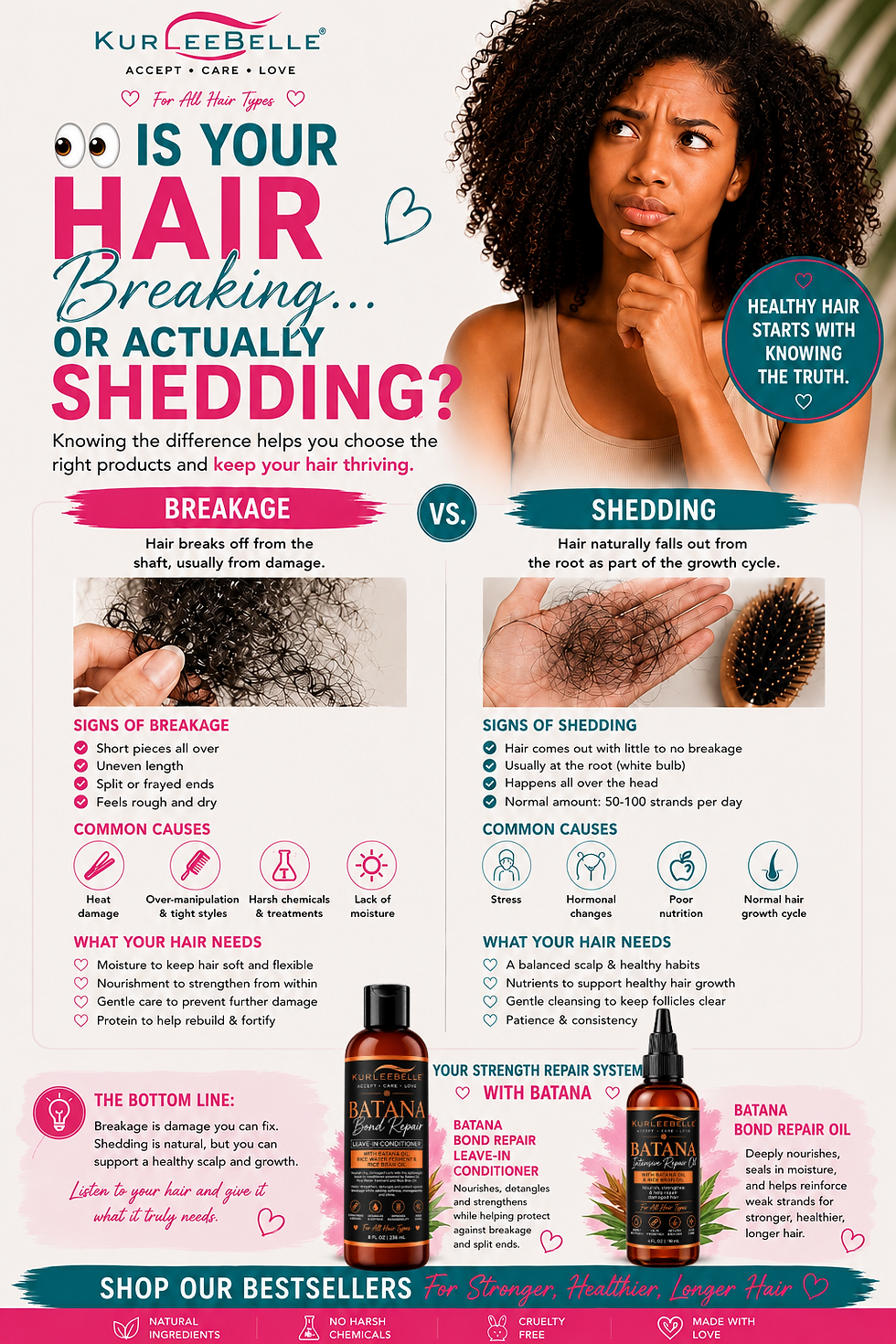
Signs that breakage may be interfering with length retention include:
Short pieces of hair on your clothes or counter
Hair snapping during detangling
Split or frayed ends
Ends that become increasingly thin
Rough or brittle hair
Excessive tangling
Uneven lengths
Hair that stays around the same length for months
Dry ends that never seem to stay moisturized
This is different from normal shedding, where a complete strand releases from the follicle as part of the hair-growth cycle.
Why Won’t My Hair Grow Past a Certain Length?
There’s a biological limit to how long individual hairs can grow based partly on the duration of their growth phase, and genetics influence that cycle.
But when someone says:
“My hair never grows past my shoulders.”
Breakage is also worth investigating.
Shoulder-length hair is constantly exposed to friction from:
Clothing. Jackets. Scarves. Towels. Pillows. Styling. Detangling.
And remember: your ends are the oldest part of your hair.
They’ve experienced every wash day, hairstyle, blow dryer, chemical treatment and detangling session since they grew from your scalp.
If you want longer hair, protecting those older strands becomes increasingly important.
7 Reasons Your Hair Is Growing but Not Getting Longer
1. Your Ends Keep Breaking
This is one of the first things to investigate.
If your hair grows half an inch but approximately half an inch breaks from your ends over the same period, the result can appear to be:
Zero growth.
But the problem isn’t necessarily growth.
It’s retention.
2. Your Hair Is Too Dry
Dry, poorly conditioned hair can be harder to detangle and more susceptible to friction and mechanical damage.
If your hair constantly feels:
Rough. Brittle. Tangled. Straw-like.
Don’t ignore it.
Your hair-care routine may need more consistent moisture and conditioning.
3. You’re Not Protecting Your Ends
Your ends need attention.
Applying products exclusively near the roots while neglecting your ends doesn’t make sense when length retention is your goal.
When moisturizing your hair, work the product through your lengths and ends.
When applying a finishing oil, concentrate particularly on areas that feel dry and fragile.
4. You’re Using Too Much Heat
Frequent high-temperature flat ironing, curling and blow drying can contribute to hair-shaft damage.
If you’re trying to retain length while repeatedly damaging the oldest portion of your hair with heat, those two goals can work against each other.
Reducing the frequency and intensity of heat styling can help limit additional damage.
5. You’re Detangling Too Aggressively
Listen closely on detangling day.
Do you hear snapping?
Do you see little pieces of hair covering your shirt or bathroom counter?
Your technique may be contributing to the problem.
Use adequate slip, work in sections and gently detangle from the ends upward instead of forcing a comb through knots.
6. Your “Protective” Styles May Not Be Protective
Braids, twists, crochet styles and wigs can reduce daily manipulation.
But a hairstyle isn’t automatically protective because we call it one.
Excessive tension, repeatedly tight installations, neglected moisture and rough takedowns can all contribute to breakage.
A protective style should help you preserve your hair, not simply hide it.
7. Your Damaged Ends Need a Trim
Products can improve softness, conditioning, lubrication and manageability.
But severely split ends cannot simply be glued permanently back together by a cosmetic product.
If an end continues splitting farther up the strand, holding onto it because you’re afraid to lose length can work against your long-term goal.
Sometimes retaining healthier length means letting severely damaged ends go.
How Do I Retain Length and Grow Longer Hair?
Instead of obsessing exclusively over stimulating your scalp, ask another question:
How can I keep more of the hair I’m already growing?
That’s where your routine changes.
For breakage-prone hair, focus on four things:
MOISTURIZE → STRENGTHEN → SEAL → PROTECT
That’s also where the Kurlee Belle Batana Bond Repair Collection fits into a length-retention routine.
Step 1: Moisturize With Batana Bond Repair Leave-In Conditioner
Dryness and breakage often go hand in hand.
The Kurlee Belle Batana Bond Repair Leave-In Conditioner is designed for dry, damaged and breakage-prone hair and features Batana Oil, Rice Water Ferment and Rice Bran Oil.
It’s formulated to help:
Moisturize dry strands
Strengthen weak hair
Help reduce breakage
Soften hair
Provide slip for detangling
Improve manageability
Add shine
Apply it to damp hair, working through your lengths and paying particular attention to dry ends.
This matters because an oil alone isn’t the same thing as water-based moisture.
Hydrate and condition first. Seal second.
Step 2: Seal and Protect With Batana Intensive Repair Oil
After applying your leave-in and styling products, follow with the Kurlee Belle Batana Intensive Repair Oil.
Featuring Batana Oil and Rice Bran Oil, it’s designed to deeply nourish dry strands, seal in moisture and help protect fragile hair.
Use a small amount to help:
Seal in moisture
Nourish dry ends
Improve softness
Reduce frizz
Add shine
Lubricate fragile strands
Protect against the dryness and friction that can contribute to breakage
Concentrate particularly on your mid-lengths and ends rather than saturating your hair.
Can Batana Oil Make Your Hair Grow Longer?
This question deserves an accurate answer.
There isn’t strong clinical evidence showing that Batana oil directly causes follicles to produce new hair faster or regrows hair lost because of a medical hair-loss condition.
But that’s different from asking whether Batana oil can be useful in a length-retention routine.
Batana oil can provide conditioning and emollient benefits that help dry hair feel softer and more lubricated.
And when breakage is what’s preventing you from seeing your length?
Protecting the strands you already have matters.
That’s the distinction:
Batana oil isn’t a magic hair-growth treatment.
It can be part of a routine designed to condition dry, breakage-prone hair and support better length retention.
That’s ultimately what you want if your hair is already growing but you aren’t keeping the length.
A Simple Length-Retention Routine for Dry, Breaking Hair
1. Cleanse
Cleanse your hair and scalp regularly enough to prevent excessive buildup.
2. Deep Condition
Give dry, damaged hair the conditioning and slip it needs before detangling.
3. Moisturize
Apply Batana Bond Repair Leave-In Conditioner to damp hair.
Work it through your lengths and ends.
4. Detangle Gently
Start at your ends and gradually work upward.
Don’t fight your hair.
If you encounter a knot, slow down.
5. Style With Minimal Tension
Choose styles that don’t require excessive pulling or manipulation.
6. Seal Your Ends
Finish with a small amount of Batana Intensive Repair Oil, concentrating on the oldest and driest parts of your hair.
7. Protect Your Hair While You Sleep
Use a satin or silk bonnet, scarf or pillowcase to reduce unnecessary overnight friction.
How Does Moisture Help With Length Retention?
Moisture isn’t a hair-growth accelerator.
But properly conditioned hair is generally easier to manipulate and detangle than extremely dry, rough hair.
That matters because every styling session creates opportunities for mechanical damage.
Think about what happens when you try to comb through extremely dry, tangled hair.
You pull harder.
The strands rub against each other.
Knots tighten.
Then—
SNAP.
The goal of your moisture routine is to help keep your hair soft, conditioned and manageable so you’re not unnecessarily sacrificing length every time you style it.
Why Do My Ends Keep Breaking Even Though I Moisturize?
If you’re moisturizing consistently and still experiencing breakage, look at the bigger picture.
Your hair may also be dealing with:
Existing heat damage
Chemical damage
Split ends
Excessive manipulation
Tight hairstyles
Rough detangling
Product buildup
Excessive friction
Poor nighttime protection
Moisture is important.
But moisture can’t compensate for repeatedly damaging your hair.
Your routine and your habits have to work together.
How Long Does It Take to See Better Length Retention?
Length retention isn’t an overnight transformation.
The goal is to gradually reduce unnecessary breakage so that, over time, more of the length you’re growing remains on your head.
Take pictures periodically rather than checking your length every morning.
Use the same hairstyle, angle and clothing reference point when possible.
Over several months, that can give you a much better picture of whether you’re actually retaining length.
Frequently Asked Questions
Why is my hair growing at the roots but not getting longer?
If you can see new growth but your overall length isn’t changing, breakage may be offsetting some of the length you’re gaining. Examine your ends and look for short broken pieces, splitting, dryness and uneven lengths.
Why does my hair stay at the same length?
Hair can appear stuck at one length when the ends break at roughly the same pace that new hair grows from the scalp. Genetics and the hair-growth cycle also influence maximum hair length.
How do I know if I’m not retaining length?
Common signs include short broken hairs, thinning ends, split ends, excessive tangling, uneven length and hair that appears to remain at the same length despite visible new growth.
Does dry hair stop growing?
Dryness along the hair shaft doesn’t necessarily mean the follicle has stopped producing hair. However, dry, brittle strands can be more susceptible to mechanical damage and breakage, making it harder to retain visible length.
Can breakage make it look like my hair isn’t growing?
Yes. If new hair is growing from the scalp while older hair is breaking from the ends, your overall length can appear unchanged.
How do I stop my ends from breaking?
Focus on consistent conditioning, gentle detangling, protecting your ends, minimizing excessive heat and tension, reducing friction and trimming severely split ends when necessary.
Is Batana oil good for length retention?
Batana oil can be useful as a conditioning oil for dry, fragile hair. While it hasn’t been proven to directly accelerate follicular hair growth, it can be incorporated into a routine designed to condition strands and reduce the factors that contribute to breakage.
Should I put Batana oil on wet or dry hair?
For a moisture-retention routine, try applying your water-based leave-in to damp hair first and using a small amount of Batana Intensive Repair Oil afterward to help seal and protect.
Why isn’t my natural hair getting longer?
Natural hair may be growing even when visible length isn’t increasing. Curl shrinkage can hide some growth, while dryness, knots, split ends, manipulation and breakage can interfere with length retention.
When should I worry about my hair not growing?
If you’re experiencing noticeable thinning, bald patches, a significant change in density, scalp symptoms or unusually heavy shedding, consider seeing a dermatologist or healthcare professional rather than assuming it’s simply a length-retention problem.
Stop Chasing Growth. Start Protecting Your Length.
If you can see new growth at your roots, your hair may already be doing exactly what you’re asking it to do:
Growing.
The question becomes:
Are you keeping what you grow?
If dry, damaged strands continually break at the ends, your hair can stay at approximately the same visible length despite months of new growth.
So shift part of your focus from simply growing hair to retaining hair.
The Kurlee Belle Batana Bond Repair Duo was created for dry, damaged and breakage-prone strands:
Batana Bond Repair Leave-In ConditionerQUENCH + STRENGTHEN
Batana Intensive Repair OilSEAL + PROTECT
Together:
MOISTURIZE → STRENGTHEN → SEAL → PROTECT
Because sometimes the secret to getting longer hair isn’t making it grow faster.
It’s keeping more of the hair you’ve already grown.
Shop the Kurlee Belle Batana Bond Repair Collection
Restore. Strengthen. Retain. Thrive.
Related Posts


Comments