
Is My Hair Breaking or Shedding? How to Tell the Difference and What Your Hair Needs
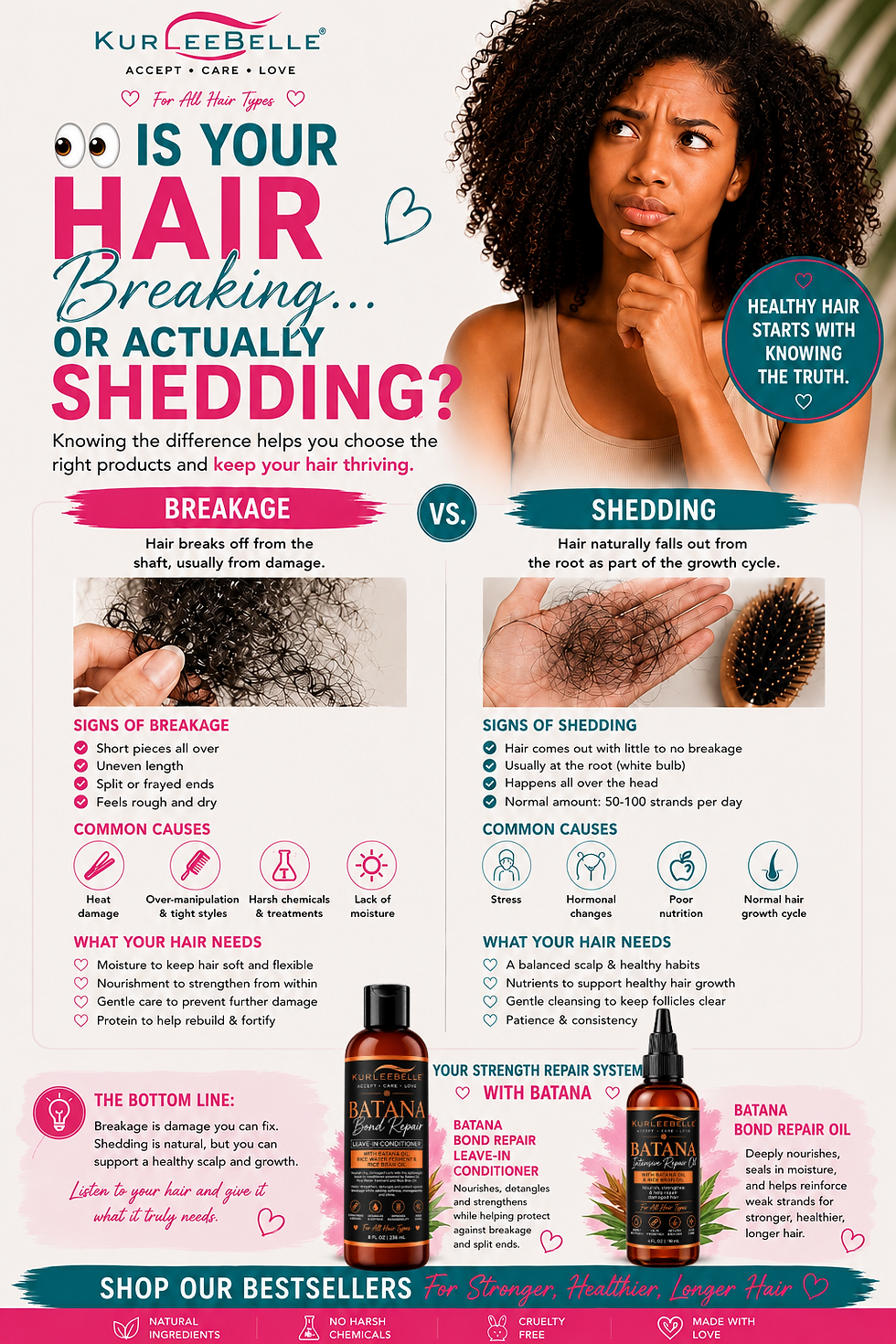
You wash your hair, look down at your hands and see strands everywhere.
Immediately, you wonder:
“Why is my hair falling out?”
But what you’re seeing may not necessarily be hair loss.
It could be hair shedding.
Or it could be hair breakage.
🌀 FREE DOWNLOAD
The Kurlee Belle Curl Guide — broken down by hair type
Find your exact routine in minutes:
→ Download Free at KurleeBelle.com/curlguide
Although the two can look similar when you’re standing over the sink or cleaning hair from your brush, breakage and shedding are not the same thing—and they shouldn’t necessarily be treated the same way.
Understanding the difference can help you figure out what your hair actually needs.
Here’s how to tell whether your hair is breaking or shedding, what can cause each and what you can do about it.
What Is the Difference Between Hair Breakage and Shedding?
Here’s the simplest answer:
Hair shedding happens when the entire strand naturally releases from the follicle as part of the hair-growth cycle.
Hair breakage happens when the hair shaft snaps somewhere along its length.
That’s why looking closely at the hair you’re losing can tell you a lot.
Hair shedding = the entire strand comes out.
Hair breakage = part of the strand snaps off.
And if your goal is longer, healthier-looking hair, identifying excessive breakage is particularly important because your hair can be growing normally from the scalp while you’re simultaneously losing length from the ends.
What Does Hair Breakage Look Like?
Hair breakage often appears as shorter pieces of hair rather than complete, full-length strands.
You may notice broken pieces:
In the sink
On your bathroom counter
On your clothing
Around your shoulders
In your comb or brush
On your pillow
During detangling
While styling
Unlike naturally shed hairs, broken hairs can be many different lengths.
Signs Your Hair May Be Breaking
Look for:
Short pieces of hair
Uneven lengths
Split or frayed ends
Rough, brittle strands
Excessive tangling
Ends that look increasingly thin
Hair snapping during detangling
Difficulty retaining length
Dryness that returns quickly
If you’re seeing lots of small pieces instead of long, complete strands, breakage may be the bigger issue.
What Does Normal Hair Shedding Look Like?
Shedding is part of the normal hair-growth cycle.
Individual follicles continuously move through phases of growth, transition and rest. Eventually, hairs in the shedding phase are released so the follicle can continue its cycle.
A shed hair is usually approximately the length of your hair because it has released from the root rather than snapping midway along the shaft.
You may also notice a small club-shaped bulb at one end of a naturally shed strand.
That doesn’t automatically mean your root was pulled out or damaged.
How Much Hair Shedding Is Normal?
It’s commonly estimated that people shed approximately 50 to 100 hairs per day, although the amount you actually notice can vary significantly.
If you wear your hair curly, braided or in another style where loose hairs aren’t removed every day, several days’ worth of shed hair can accumulate.
That means wash day can look alarming.
Imagine shedding around 50 hairs per day but only thoroughly detangling once every seven days.
You’re potentially seeing several days of naturally shed strands at once.
So a large amount of hair in your hands on wash day doesn’t automatically mean you’re experiencing abnormal hair loss.
Look at the strands themselves—not just the size of the hairball.
How Can I Tell if My Hair Is Breaking or Shedding?
Try this simple check.
Take a few strands you’re finding during wash day or detangling and examine them.
You’re more likely seeing shedding if:
The hairs are close to your normal hair length and appear to be complete strands.
You’re more likely seeing breakage if:
You’re finding many short pieces of different lengths, especially alongside rough ends, split ends and increasing difficulty retaining length.
You can experience both at the same time, too.
Normal shedding can occur while damaged portions of your hair are also breaking.
Why Is My Hair Breaking So Much?
If you’ve determined that you’re dealing with breakage, the next question is:
Why?
Several factors can contribute.
1. Severe Dryness
Dry, poorly conditioned hair may experience greater friction during detangling and styling.
If your hair feels rough, brittle and constantly tangled, your moisture and conditioning routine deserves attention.
2. Excessive Heat
Repeated flat ironing, curling and high-temperature blow drying can damage the hair shaft.
Over time, hair may become:
Dry → weak → brittle → prone to breakage.
If you’re experiencing breakage, reducing your heat frequency may help prevent additional damage.
3. Bleach and Chemical Processing
Bleaching, coloring, relaxing and other chemical processes alter the hair’s structure.
Overprocessing can leave hair weaker and more susceptible to breakage.
4. Over-Manipulation
Your products aren’t the only thing affecting your hair.
How you handle it matters.
Aggressive detangling, excessive brushing, repeatedly restyling and pulling the hair can contribute to mechanical damage.
5. Tight Hairstyles
Braids, ponytails, wigs and other protective styles aren’t truly protective if they’re constantly putting excessive tension on your hair.
Pay particular attention to your edges.
If your hairstyle hurts, feels excessively tight or pulls strongly at your hairline, don’t ignore it.
6. Neglected Ends
Your ends are the oldest portion of your hair.
They’ve experienced years of washing, styling, weather, friction and manipulation.
When your ends become extremely dry and split, they can begin breaking faster than you’re retaining new length.
Why Is My Hair Shedding More Than Usual?
Not every increase in shedding is caused by your hair products.
Temporary or excessive shedding can be associated with many factors, including illness, major physical or emotional stress, hormonal changes, nutritional deficiencies, medications and other health conditions.
That’s why it’s important not to automatically treat significant shedding as a cosmetic problem.
If you’re experiencing sudden excessive shedding, noticeable thinning, bald patches, scalp symptoms or a persistent change in your hair density, speak with a dermatologist or healthcare professional.
Hair products can condition the strands.
They cannot diagnose or treat an underlying medical cause of hair loss.
Hair Breakage vs. Hair Loss: They’re Not the Same Thing
This distinction is important.
If your hair is breaking halfway down the strand, your follicles may still be producing hair normally.
The problem is that you’re not retaining the length you’re growing.
Imagine your hair grows from the scalp every month.
But the ends continually break.
You look in the mirror six months later and think:
“My hair isn’t growing.”
It may actually be growing.
You’re simply losing length at approximately the same rate you’re gaining it.
That’s why addressing breakage can make such a dramatic difference in your length-retention journey.
How Do You Stop Hair Breakage?
There isn’t one miracle product that can permanently repair every type of hair damage.
Instead, focus on creating an environment that helps prevent additional breakage.
Start with these priorities:
Moisture
Dry hair needs water-based moisture and conditioning.
Gentle Detangling
Use products that provide enough slip to help minimize unnecessary pulling.
Reduced Manipulation
You don’t need to restyle your hair every day.
Protection
Protect your ends and reduce friction, particularly while sleeping.
Consistency
Healthy-looking hair usually comes from what you do repeatedly—not what you do once.
Your Breakage Routine: Moisturize First, Then Protect
If dryness and breakage are your biggest concerns, don’t simply coat already-dry hair with more oil.
Start with moisture.
Then seal and protect.
That’s the philosophy behind the Kurlee Belle Batana Bond Repair Duo.
Step 1: Batana Bond Repair Leave-In Conditioner
The Kurlee Belle Batana Bond Repair Leave-In Conditioner is designed for dry, damaged and breakage-prone hair.
Featuring Batana Oil, Rice Water Ferment and Rice Bran Oil, it helps provide the moisture and conditioning fragile hair needs while improving softness and manageability.
Use it to help:
Moisturize dry strands
Strengthen fragile hair
Reduce breakage
Improve detangling
Increase softness
Improve manageability
Add shine
Apply the leave-in to damp hair after cleansing and conditioning.
Pay special attention to dry, fragile areas and your ends.
Step 2: Batana Intensive Repair Oil
Once you’ve moisturized your hair, follow with Kurlee Belle Batana Intensive Repair Oil.
Featuring Batana Oil and Rice Bran Oil, the finishing oil helps nourish dry strands and seal in moisture.
Use it to help:
Seal in moisture
Nourish dry hair
Smooth frizz
Lubricate fragile strands
Protect dry ends
Improve softness
Add shine
You don’t need to saturate your hair.
Apply a small amount, concentrating primarily on your lengths and ends.
Think of the routine as:
QUENCH → STRENGTHEN → SEAL → PROTECT
Can Batana Oil Stop Hair Shedding?
This is where we need to separate cosmetic hair care from medical hair loss.
Batana oil has not been proven to stop physiological hair shedding or treat medical hair loss.
If hair is naturally reaching the end of its growth cycle, applying oil to it isn’t going to prevent that normal process.
Where Batana oil can be more relevant is conditioning dry, fragile hair.
By helping lubricate and condition the strands, oils can be useful as part of a routine designed to reduce the conditions that contribute to mechanical breakage.
That’s why our Batana collection is positioned around moisture, strengthening, protection and breakage reduction—not promising to stop normal shedding.
How to Build a Routine for Breakage-Prone Hair
If you’re seeing broken hairs everywhere, simplify your routine.
1. Cleanse
Keep your scalp and hair clean and remove excessive buildup.
2. Deep Condition
Give dry strands conditioning, softness and slip.
3. Moisturize
Apply Batana Bond Repair Leave-In Conditioner to damp hair.
4. Detangle Gently
Work in sections and start at the ends rather than ripping through knots from the roots downward.
5. Style
Choose styles that don’t create unnecessary tension.
6. Seal
Apply a small amount of Batana Intensive Repair Oil, concentrating on your lengths and ends.
7. Protect at Night
Sleep with a satin or silk bonnet, scarf or pillowcase to reduce friction.
Does Hair Breakage Affect Hair Growth?
Breakage doesn’t necessarily mean your follicles have stopped growing hair.
But it can prevent you from seeing your growth.
This is the concept of length retention.
Hair growth happens at your scalp.
Length retention happens along your strands.
You need healthy growth and adequate length retention if your goal is visibly longer hair.
Reducing breakage allows you to preserve more of the hair you’ve already grown.
Frequently Asked Questions About Hair Breakage vs. Shedding
How do I know if my hair is breaking or shedding?
Look at the strands you’re losing. Naturally shed hairs are generally full-length strands released from the follicle, while breakage tends to produce shorter pieces of varying lengths. Split ends, roughness and uneven length can also point toward breakage.
Does a white bulb mean my hair is shedding?
A small club-shaped bulb at one end can indicate that a strand was naturally shed from the follicle. It doesn’t necessarily mean the follicle itself has been pulled out.
Why am I finding short pieces of hair everywhere?
Short pieces can be a sign of hair breakage, especially if your hair is also dry, brittle, split or difficult to detangle.
Why is my hair breaking when I comb it?
Dryness, tangles, excessive manipulation, chemical damage and heat damage can all make hair more vulnerable to breakage during detangling. Use adequate conditioning and slip, work in sections and detangle gently.
Is 50–100 hairs a day normal?
Approximately 50–100 shed hairs per day is often cited as a typical range, although individual shedding varies. People who don’t detangle daily may notice several days of shed hairs at once.
Can dry hair cause breakage?
Severely dry or poorly conditioned hair can become harder to detangle and more vulnerable to friction and mechanical damage, which can contribute to breakage.
How can I reduce hair breakage naturally?
Focus on keeping your hair appropriately moisturized and conditioned, minimizing excessive heat and chemical processing, detangling gently, avoiding excessive tension and protecting your hair from unnecessary friction.
When should I worry about excessive shedding?
Consider speaking with a dermatologist or healthcare professional if you notice a sudden or persistent increase in shedding, visible thinning, widening areas of scalp, bald patches or other significant changes.
The Bottom Line: Is Your Hair Breaking or Shedding?
Before buying another product to “stop hair fall,” figure out what you’re actually seeing.
SHEDDING: The entire strand releases from the follicle as part of the hair-growth cycle.
BREAKAGE: The strand snaps somewhere along the hair shaft.
If you’re experiencing dryness, brittle ends, short broken pieces and difficulty retaining length, your hair may need a routine focused on moisture, conditioning and reducing additional damage.
That’s where the Kurlee Belle Batana Bond Repair Duo comes in.
Batana Bond Repair Leave-In Conditioner
Moisturize. Strengthen. Detangle. Soften.
Batana Intensive Repair Oil
Nourish. Seal. Protect. Shine.
Together, they’re your Strength + Repair System with Batana for dry, damaged and breakage-prone hair.
Because when you understand what your hair is telling you, you can finally give it what it needs.
Restore. Strengthen. Thrive.
Related Posts


Comments